The International Team’s Drought: Is This the Roster That Finally Ends It?
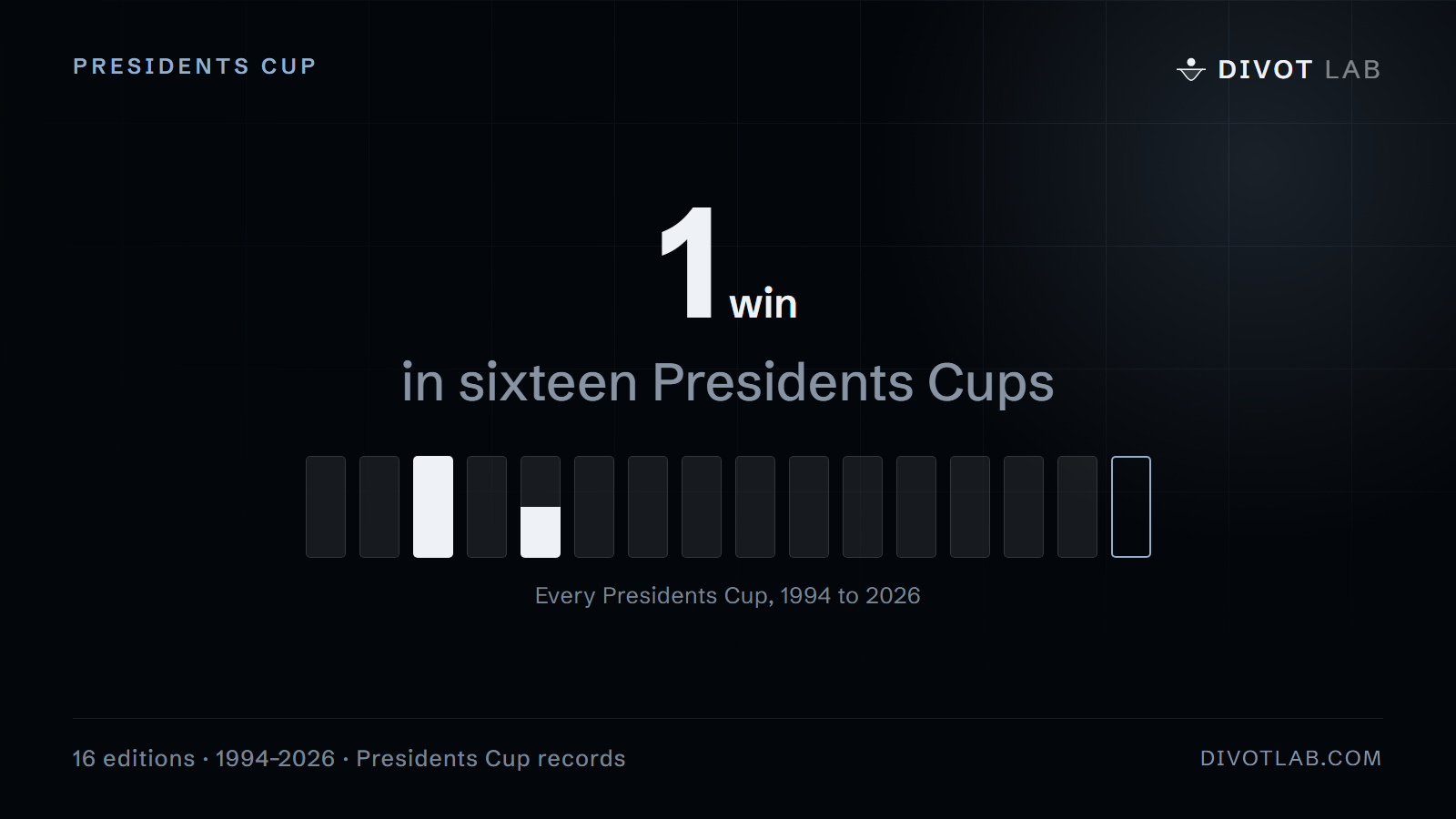
The International team has won the Presidents Cup once, in 1998. Geoff Ogilvy has built a roster around continuity and a course he helped redesign — here is what that changes, and what it does not.
On this page
The International team hasn’t won the Presidents Cup since 1998. In the twenty-eight years since, they have managed one tie and eleven losses.
The tie came in 2003. That match was so deadlocked it went to a three-hole aggregate playoff, and officials finally called it a draw at dusk. It remains one of the most lopsided head-to-head records in modern team sports.
This year the man asked to break it has lived the losing side of it up close. Geoff Ogilvy played for the International team in 2007, 2009 and 2011. He now captains it at a course his own firm redesigned.
Why the gap has been so hard to close
The structural problem has never really been star power at the top. It is depth and continuity.
The U.S. draws from a single deep domestic tour with a consistent pipeline: PGA Tour University, college golf and developmental tours all feed one system. Those players see each other constantly — at majors, at FedEx Cup events, and now at signature events too.
The International team pulls from a dozen countries and tours. Its players often arrive with far less history alongside each other.
The obvious place to expect that to show up is foursomes. Alternate shot is the format that most rewards a settled rhythm and shared course-management instincts, and pairings without real reps together ought to be the ones it punishes.
Except that is not what happened last time.
At Royal Montreal in 2024, the U.S. swept Thursday four-ball 5–0 — and the International team swept Friday foursomes 5–0 right back. Saturday split 3–1 each way. Seven matches reached the 18th hole. The final score was 18.5–11.5.
That is worth sitting with, because it complicates the tidy version of this story. The continuity argument is real at the level of program — the U.S. keeps its core together for years — but the last edition offers no evidence that the International team cannot play alternate shot. It offers fairly strong evidence that they can. What they could not do at Royal Montreal was hold on through Sunday singles, which is a depth problem, not a chemistry one.
What’s different about the 2026 roster
Ogilvy’s approach to building this roster suggests he is aware of that history and trying to address it directly. His six captain’s picks split cleanly into two groups.
Continuity: Corey Conners, Sungjae Im and Christiaan Bezuidenhout all played the 2022 edition at Quail Hollow and the 2024 edition at Royal Montreal. Half of Ogilvy’s picks arrive with real partnership data — earned in two losing efforts, but earned.
Fresh energy: Nick Taylor, Nico Echavarria and Ryo Hisatsune are newcomers to the event, none carrying a major title but all in strong recent form.
That’s a deliberate bet: keep enough continuity to avoid rebuilding chemistry from scratch, while adding players who haven’t yet absorbed the psychological weight of the losing streak. It is a different formula from past International sides, which have sometimes leaned heavily on star power — the Ernie Els era around 2019 — or on youth all at once.
The case for, and against, this being the year
The case for. Three major champions headline the automatic qualifiers: Hideki Matsuyama, Adam Scott, and Ryan Fox, who won the 2026 Open Championship at Royal Birkdale. That is more top-end firepower than several recent editions have carried.
And then there is the captain. Ogilvy is a partner in OCM — Ogilvy, Cocking and Mead — the firm Medinah hired to redesign Course No. 3. The $23.5 million project added three new holes and reopened in 2024.
So every player in the field is looking at a golf course that did not exist in this form the last time anyone competed on it. One of them has spent years inside its drawings.
Ogilvy went 7–6–1 as a player in this event, including 3–1–1 at Royal Melbourne in 2011. He is the rare captain who has been on the wrong end of this record himself.
The case against. The U.S. roster still carries more top-15 world-ranked players. Si Woo Kim is the only International player currently inside the world’s top 20.
That gap shows up hardest in Sunday singles, where depth matters more than any pairing decision. It is precisely where Royal Montreal was decided. And twenty-eight years of losing is a weight that does not lift because the roster construction looks smarter on paper.
Our own course-fit model is no help here, and it is worth saying why. It is built on stroke play against a full field. Match play breaks both halves of that: the sample is one opponent, the pairings are chosen by a captain, and the outcome is head-to-head rather than field-relative. Anyone selling you a number on this week is selling you something.
Medinah is the sixteenth Presidents Cup. It is the thirteenth time the International team has been asked this question since the last time the answer was yes.
The roster is the best answer Ogilvy could give to a problem he spent three appearances living inside. Sunday afternoon will say whether it was the right one.