Reading Medinah No. 3: The Course Ogilvy Built, and the Routing Nobody Has Seen
The International captain’s own firm redesigned Medinah No. 3, and the Presidents Cup will be played on a routing that starts at the members’ fifth hole. Here is what changed and where the matches will actually turn.
On this page
The International captain helped design the golf course.
Geoff Ogilvy is the O in OCM, the Australian firm Medinah hired to rebuild Course No. 3. The work ran through 2023 and 2024, cost a reported $23.5 million, and added three holes that did not previously exist. He was named International captain after the drawings were done. So the man trying to end a twenty-eight-year losing streak spent years inside the plans for the ground it will be decided on.
That is the detail every preview leads with. The more useful one is quieter.
The holes you hear on TV are not the holes on the scorecard
Medinah will play a different routing this week than its members play. The Presidents Cup starts on the members’ fifth hole. It runs through their 18th — which becomes the 14th of the match — and then finishes on their opening four, renumbered 15 through 18.
The reason is match play. Under the members’ numbering, the dramatic water holes along Lake Kadijah sit at 16, 17 and 18, and a lopsided match would be over before anyone reached them. Moving them to 12, 13 and 14 puts the best ground at the point where matches are still alive.
Under the Presidents Cup routing, play begins at the members’ 5th and their 18th green becomes the 14th. The members’ 1st through 4th close the round as 15 through 18.
Keep that straight before Thursday. Almost every hole reference published this month uses one numbering or the other without saying which.
What OCM actually changed
The old Medinah was a tree-lined corridor course. You hit it straight or you chipped out sideways, and the defence was width — or the lack of it.
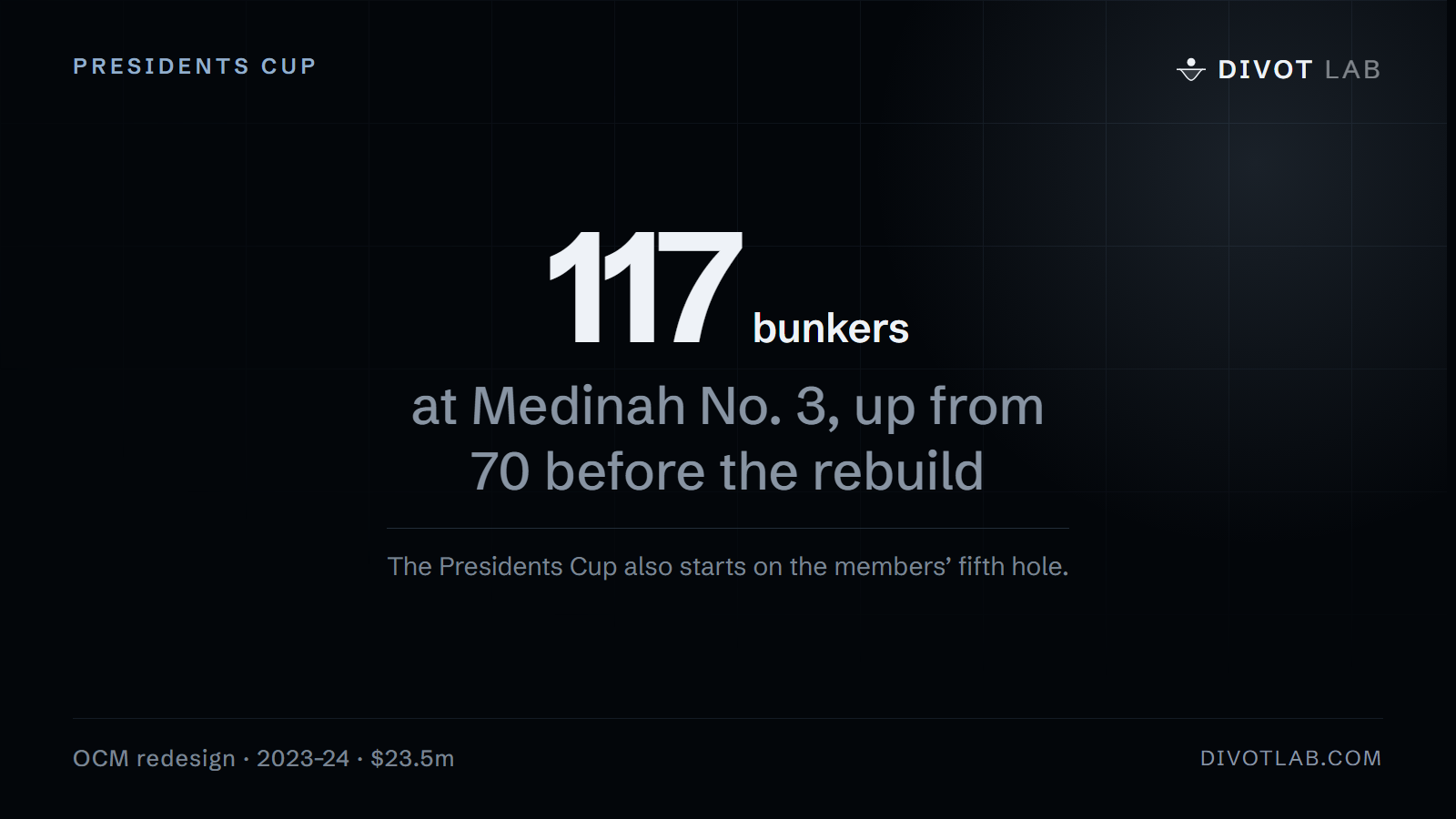
OCM took the trees down and put the difficulty somewhere else. Bunkers went from 70 to 117. Greens were expanded to open up pin positions that the smaller surfaces could not hold. Fairways got wider, which sounds like a concession and is not one.
The thinking traces back to Tom Bendelow’s 1928 routing, and to a fairly old idea: a wide fairway with a right side and a wrong side asks a better question than a narrow one that only asks whether you can hit it straight. The angle into the green becomes the test.
The greens are bentgrass, average roughly 8,600 square feet, and are being set up to run near 13 on the Stimpmeter. That is fast for surfaces that size and that contoured. Long-range putting becomes a real skill rather than a formality, which matters more in fourball than most people expect.
Where the matches should turn
Three holes stand out, and all three are in the stretch the routing was rearranged to protect.
The 12th (par 4, roughly 400 yards) is the one to watch. OCM replaced the old cross-water hole with a par 4 that runs diagonally along Lake Kadijah, so every player chooses privately how much water to take on. The safe line is longer. The aggressive line leaves a wedge. In match play, that decision gets made after you have seen what your opponent did — which is the whole point of building it that way.
The 13th (par 3, over 200 yards) crosses the same lake immediately afterward. Back-to-back water holes at the business end of a match is not an accident.
The 4th (373 yards) is the short par 4 and the clearest invitation to be aggressive early. The longest hitters can get there.
Two of the four days are fourball, where one player can afford to take the aggressive line because his partner is already safe. Medinah will see more attempts at the 12th than a stroke-play field would risk.
What it means for pairings
Wide fairways and firm, quick greens shift value away from raw distance and toward approach play and speed control on the greens. That points to pairing a long hitter with a precise iron player rather than stacking two bombers — one to reach the par 5s, one to hold the surfaces.
It is worth being honest about the limits of that conclusion. It is reasoning from architecture, not from results. Nobody has competitive data on this golf course, because in this configuration nobody has played it. The last significant event at Medinah was the 2012 Ryder Cup, on a course that has since been rebuilt and renumbered.
Our own course-fit model cannot help either, for reasons worth stating plainly: it is built on stroke play against a full field, and match play breaks both halves of that. We wrote about that in more detail in our look at the International team’s twenty-eight-year drought.
So the honest position is that the architecture suggests a preference, and the week will test it.
Which leaves the question the whole event is quietly asking. Ogilvy knows every slope on the property and drew a good many of them himself. But a captain does not hit a golf ball, and knowing where the trouble sits has never been the hard part of avoiding it.